Author: Kiyana Rahimian
“Pick all the cells with traffic lights”… Often, when opening a website, users have to verify that they’re not automated software by completing a test where they select certain parts of a picture. Such tests are types of Automated Turing tests. The Turing test, developed by Alan Turing, helps determine if technology can replicate human intelligence. As of now, even though engineering has sought to replicate brain-like functions through developing artificial intelligence (AI), there’s been no success in replicating human brain functions. Although the human brain processes basic information, like numbers, at slower rates than machines, they are better able to process complex information. Intuitive reasoning gives human brains the means to perform considerably better with little, diverse, and/or incomplete information.8 Compared to silicon-based computers, human brains are better at data storage and are way more energy efficient. AlphaGo, the first computer to beat a human at a board game required 4*10^10 J to complete its task. This amount of energy could sustain an adult human for 10 years.9 For these reasons, efforts are being made to develop systems which use neural tissue as computational substrates.8
Research has been done to integrate 2D neural cultures with computer systems. A 2-dimensional human neural culture, referred to as the “Dishbrain system” learned how to play the computer game pong. It was trained by a high-density multi-electrode device and after five minutes, there were signs of learning as it gave less random outputs. This can be explained by the free-energy principle which proposes the idea that living things strive to reduce randomness.8 A computer would be unable to “learn” the game in such a limited amount of runs.
One major downfall of the Dishbrain system is that it forgets its training the following day. This is because it lacks the machinery, the glial cells, required for long-term learning. The mono-layer characteristic of these neural cultures makes them unable to develop advanced neural networks. To overcome this limitation, scientists are trying to develop organoid intelligence(OI) and expand brain-directed OI computing.
Organoids are miniature organ-like structures that replicate organ architecture and function. They are 3D tiny spherical masses, typically 500 micrometers diameters, of organ tissues (see Figure 1).8 Organoids are much better replicas of human brains compared to their 2D counterparts (see Figure 2). For one, their 3D structure increases cell density permitting neurons to form more connections.4 Also, unlike the mono-layer neural culture used in the Dishbrain systems, current organoids can advance in plasticity and long-term memory because they contain glial cells. Similar to brains which have extensive myelination of 50%, brain organoids have 40% myelination. Myelination helps with biological computing because myelin acts as an electrical insulator and increases electrical conductivity. Organoids perform computations by connecting with an array of metal electrodes which detect brain activity and transmit information to computers, which interpret and analyze signals.8
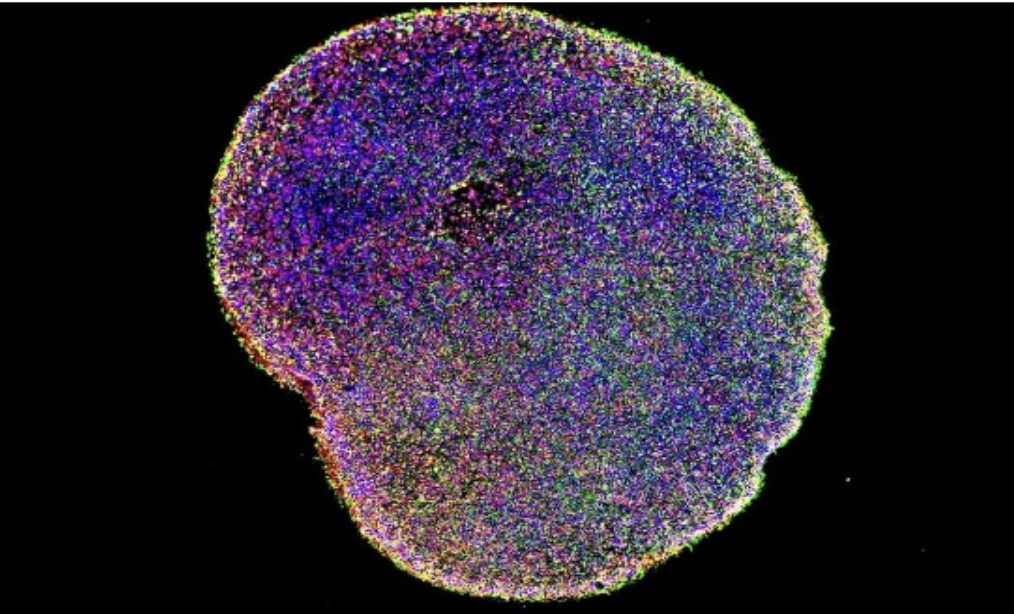
Figure 1. A photograph of a 6 month old neural organoid made in Paola Arlotta laboratory that was stained to highlight different cell types.6
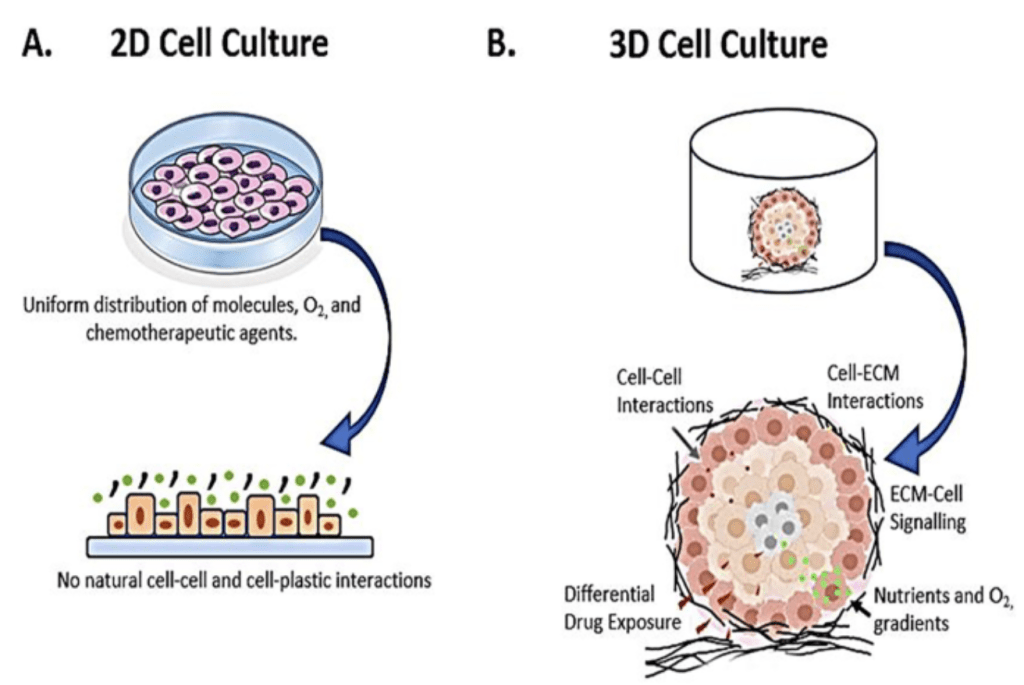
Figure 2. A representation of a 2 Cell culture and a 3D cell culture and some of the interactions involved in each culture type.2
Our ability to grow organoids is thanks to recent bioengineering breakthroughs. IPSC stands for induced pluripotent stem cells. They are created by turning adult cells back into stem cells which can develop into any other cell type in the body (1). Organoids derived from IPSCs are capable of growing vertically and horizontally thanks to recent developments in 3D cell culturing techniques.1,8
It’s very difficult to accumulate brain tissue to do research on. Thus, in addition to OI advancing biocomputing, organoids can act as a research tool for neuroscience, drug development, and the development of precise medical treatment plans. Organoids derived from stem cells of patients with diseases can be used to test drugs to tailor medical treatments to individuals.7
Current brain organoids are incapable of supporting complicated, sophisticated computations. For them to support higher computational power, they need to significantly increase in size from 50 000 cells to 1 billion cells.8 Current organoids are avascular and rely on passive diffusion of nutrients and oxygen. However, larger organoids would be incapable of relying on this mechanism and would experience necrosis. For a size increase, the involvement of artificial blood systems is needed to allow for the perfusion of oxygen, nutrients, and homeostasis.
Microfluidic systems, a new technology, can act as the vasculature for organoids as they allow for small-scale manipulation of fluids (see Figure 3). These systems also support computation by permitting communication through chemical signals.9
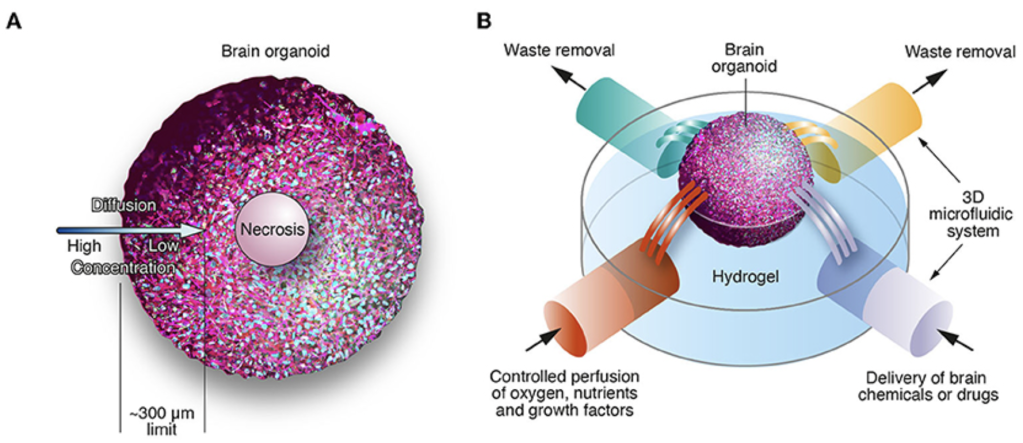
Figure 3. (A) A visual representation of how because passive diffusion can only penetrate depths of 300 micrometers, oxygen and nutrients are unable to diffuse into an organoid. This causes the core of larger organoids to starve and experience necrosis. (B) A representation of the microfluidic system which may allow organoids to increase in size by allowing for controlled perfusion of oxygen and nutrients.7
Although organoids present an interesting alternative to AI technologies, they come with many ethical considerations. For one, it is difficult to determine the relationship between the stem cell donor and the respective OI system. In their present small form, emotional content can not be inputted into organoids. However, as we continue to develop them, one major question is if they can develop emotional intelligence or sentience? So the question arises; should we continue advancing OI?
Works Cited
- Barreras P, Pamies D, Monaco MC, Muñoz LS, Zhong X, Major EO, et al. A human-derived 3D brain organoid model to study JC virus infection. J Neurovirol. 2022 Feb;28(1):17–26.
- Biju TS, Priya VV, Francis AP. Role of three-dimensional cell culture in therapeutics and diagnostics: an updated review. Drug Deliv and Transl Res. 2023 Sep;13(9):2239–53.
- Chopra H, Munjal K, Emran TB. Artificial intelligence 2.0: Taking organoid intelligence a step ahead. International Journal of Surgery Open. 2023 Nov;60:100693.
- Hollender L. Scientists unveil plan to create biocomputers powered by human brain cells. Frontiers Science Communications [Internet]. 2023 Feb 28 [cited 2024 Feb 4]; Available from: https://www.frontiersin.org/news/2023/02/28/brain-organoids-intelligence-biocomoputing-hartung
- Nolan M. Organoid Intelligence: Computing on the Brain. IEEE Spectrum [Internet]. 2023 Apr 23 [cited 2024 Feb 4]; Available from: https://spectrum.ieee.org/organoid-intelligence-computing-on-brain
- Rowlands L. Improvements in brain organoids open new doors in neurological research. Physics World [Internet]. 2019 Jul 24 [cited 2024 Feb 4]; Available from: https://physicsworld.com/a/improvements-in-brain-organoids-open-new-doors-in-neurological-research/
- Shi H, Kowalczewski A, Vu D, Liu X, Salekin A, Yang H, et al. Organoid intelligence: Integration of organoid technology and artificial intelligence in the new era of in vitro models. Medicine in Novel Technology and Devices. 2024 Mar;21:100276.
- Smirnova L. Organoid intelligence (OI) – The ultimate functionality of a brain microphysiological system. ALTEX. 2023;191–203.
- Smirnova L, Caffo BS, Gracias DH, Huang Q, Morales Pantoja IE, Tang B, et al. Organoid intelligence (OI): the new frontier in biocomputing and intelligence-in-a-dish. Front Sci. 2023 Feb 28;1:1017235.
 McMaster HealthTech
Leave a reply to Replacing the A in AI: Unleashing the Power of Miniature Minds Cancel reply