Author: Ashley Smith
Embarking on new advances in health technology, gene therapy stands as the most thrilling, yet nerve-wracking breakthroughs. Enter CRISPR — a revolutionary tool that sparks a cascade of questions: What is CRISPR? How does it work? Is gene therapy safe? Across the world, a community of dedicated scientists, physicians, nurses, and health care providers eagerly seek answers, as CRISPR has the potential to conquer humanity’s deadliest diseases and disorders.
The term ‘Soft CRISPR’ has captured attention in recent news, highlighting a revolutionary method for scientists to edit and modify genes in our DNA. In cases where a person has a genetic disorder, they carry two distinct mutations on their chromosomes: one inherited from their mom, and another from their dad1. Soft CRISPR works by taking advantage of the fact that a mutation on some chromosomes might have a functional sequence on its pair chromosome2. The healthy genetic information on one chromosome can then be used to repair the defective chromosome after the DNA strand is cut1. In Soft CRISPR, a protein called the nickase-based system, selectively targets one strand of DNA, and delicately creates a “soft nick”, to allow for repairments in the DNA sequence1.
In previous iterations of CRISPR technologies, specifically CRISPR Cas9, it operates slightly differently than Soft CRISPR. In CRISPR Cas9, there is the Cas9 protein, which is used to cut the DNA3. The Cas9 protein involves a guide RNA, which is used to recognize which DNA sequence is defective, and needs to be edited4. Together, both the Cas9, and guide RNA, recognize the appropriate DNA sequence, executes a precise incision of the sequence, and then modify the genetic information, either through deleting, inserting, or changing base pair sequences (see Figure 1)5.
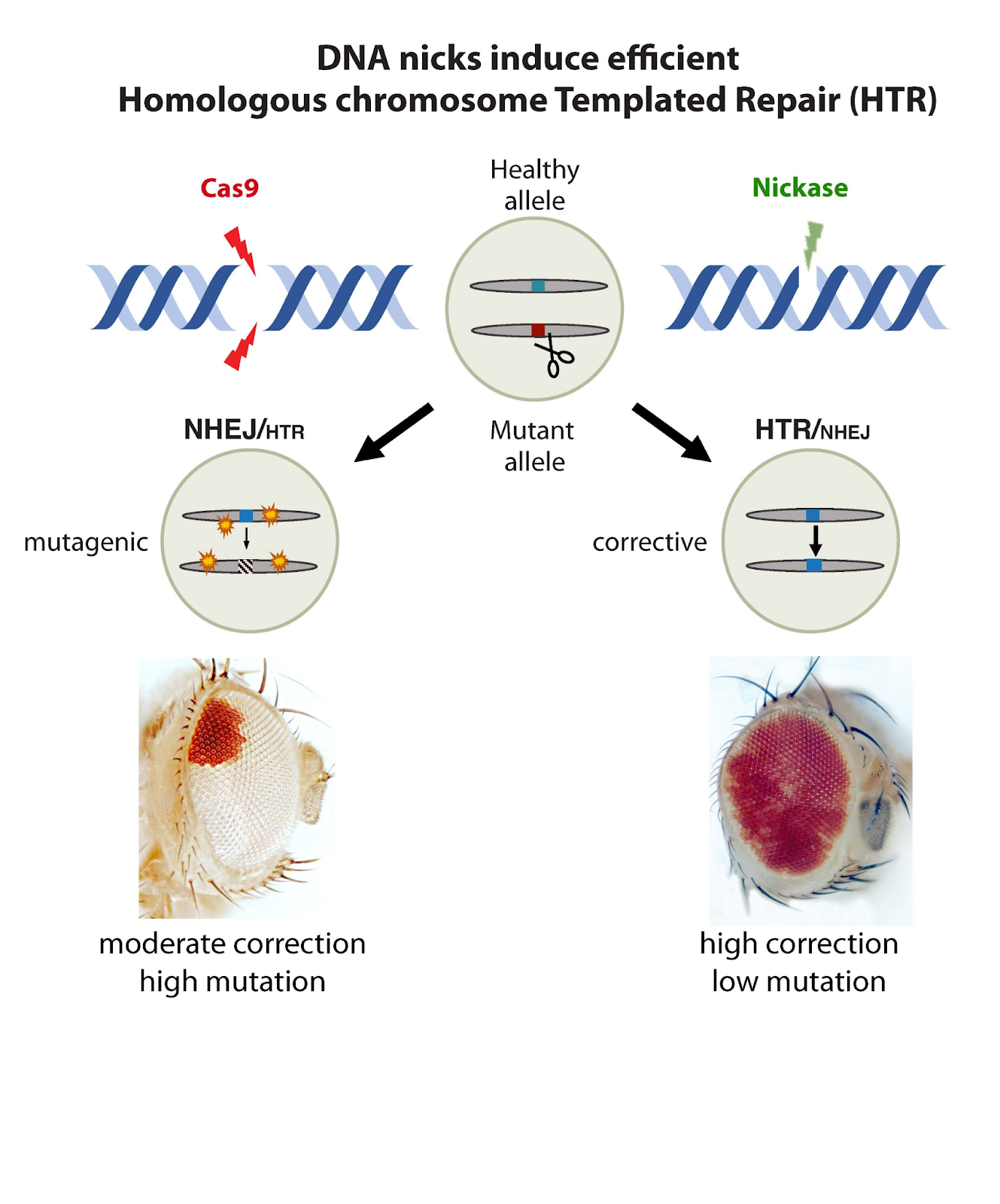
Figure 1. Flowchart illustrating restorative gene editing using sequences from the counterpart chromosome. Though standard CRISPR-Cas9 facilitates DNA repair, it can also induce unintentional mutations at the target site (left). Comparatively, the nickase enzyme enables greater efficiency in gene correction without mutagenic events (right)6.
Soft CRISPR represents an advancement over the conventional CRISPR Cas9 model, showcasing several key advantages. Soft CRISPR uses the nickase base-system that targets, and cleaves one strand of DNA, instead of the dual-strand approach employed by earlier CRISPR Cas9 technologies1. Soft CRISPR’s innovative strategy yields a substantial improvement in repair success rates, with Soft CRISPR demonstrating a 50-65% success rate compared to the 20-30% success rate observed with Cas9’s dual cutting strands1. The Soft CRISPR demonstrates simplicity in its method, by utilizing “soft” nicks in DNA, rather than Cas9’s full DNA breaks in both DNA strands1. Consequently, when there is a break in a DNA strand, it can cause “on and off target mutations”2. On and off target mutations happen when CRISPR is trying to repair a mutation in the DNA, but cause other non-targeted sites in the DNA to be disrupted, and pose a potential threat to stability2. Interestingly, Soft CRISPR exhibits far fewer on and off mutations, compared to the traditional CRISPR Cas9 method1. The cumulative differences between Soft CRISPR and the traditional CRISPR Cas9 method are distinct, and signifies Soft CRISPR’s potential for groundbreaking advancements in medicine.
The advancements with Soft CRISPR, compared to traditional CRISPR Cas9 demonstrate profound implications for the trajectory of medicine innovation. Although the CRISPR technology remains a work in progress, each advancement and breakthrough will greatly transform medicine as a whole. CRISPR has the potential to revolutionize the lives of patients, both emotionally and genetically. With each passing year, scientists are advancing towards a future, where patient care is elevated to new heights.
Works Cited
1. Roy S, Juste SS, Sneider M, Auradkar A, Klanseck C, Li Z, et al. Cas9/Nickase-induced allelic conversion by homologous chromosome-templated repair in Drosophila somatic cells. Sci Adv. 2022 Jul;8(26):eabo0721.
2. Guo C, Ma X, Gao F, Guo Y. Off-target effects in CRISPR/Cas9 gene editing. Front Bioeng Biotechnol. 2023 Mar 9;11:1143157.
3. Ran FA, Hsu PD, Wright J, Agarwala V, Scott DA, Zhang F. Genome engineering using the CRISPR-Cas9 system. Nat Protoc. 2013 Nov;8(11):2281–308.
4. Redman M, King A, Watson C, King D. What is CRISPR/Cas9? Arch Dis Child Educ Pract Ed. 2016 Aug;101(4):213–5.
5. Xu Y, Li Z. CRISPR-Cas systems: Overview, innovations and applications in human disease research and gene therapy. Computational and Structural Biotechnology Journal. 2020;18:2401–15.
6. Leal AF, Alméciga-Díaz CJ. Efficient CRISPR/Cas9 nickase-mediated genome editing in an in vitro model of mucopolysaccharidosis IVA. Gene Ther. 2023 Feb;30(1–2):107–14.
 McMaster HealthTech
Leave a comment