Grishm Trivedi – Honors Neuroscience Level II
In recent years, the discussion around neurological implants and brain-computer interfaces has gained prominence, showcasing the growing connection between medicine and technology. The brain is an important and delicate organ of the human body that has been very difficult to treat. One small error may lead to a risky and dangerous consequence, possibly leading to an impairment of the patient. However, with the recent development of various technological advancements, there is now a way to aid the treatment of various neurological disorders with the use of neurotechnology and brain-computer interfaces.3
Brain-Computer Interfaces (BCIs) are machines that allow patients to transfer their brain signals to outer machines, such as prosthetic limbs.5 The machines can translate the action potentials sent from the central nervous system and create an output command that can perform a desired task. Neural signals and activities can be measured using electroencephalography (EEGs).2 allowing for an electrode to directly measure any depolarization in the brain. During the depolarization of the primary motor cortex – where various parts of the human body are topographically mapped – a threshold membrane potential can be reached and a signal is transmitted. For example, if one were to want to move their left arm, an action potential would begin in the neurons on the right side of the primary motor cortex in the brain. The electrical signal comes as sodium ions enter a cell and cause the inner cell potential to pass a threshold voltage (often -55mV). Similarly, the magnetic signals can also be picked up through sensors used in functional magnetic imaging (fMRI).5
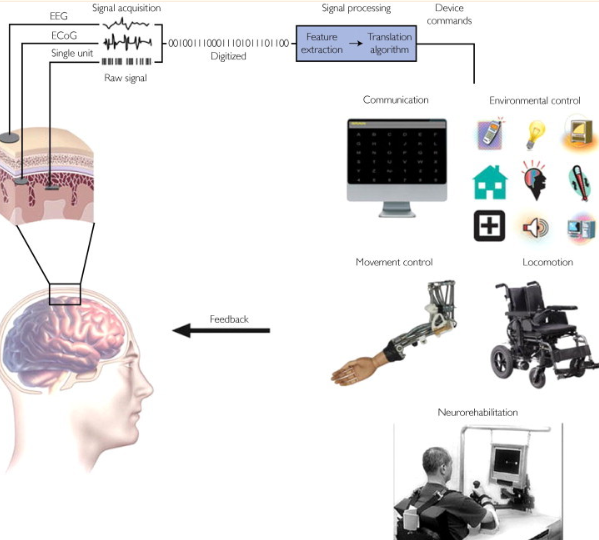
Figure 1: A simplified flowchart illustrating the process of how BCIs transfer brain signals to the output machines. Source: Brain-Computer Interfaces in Medicine.5
Once the excitatory response is elicited, the voltage change of neuronal action potentials are detected by BCI sensors, it is processed by computer algorithms and translated into a command, allowing for a mechanical output to occur. An important requirement of BCIs is high precision and accuracy, with a minor electrode needed to be implanted to acquire data. However, a benefit is that the techniques can be invasive (like inserting an actual electrode) or noninvasive (like the use of EEG caps).4
The important aspect of advancements in neurotechnology and BCIs is the benefits it can bring to patients with mobility issues or possible lesions to varying parts of the central nervous system. For example, many patients with amyotrophic lateral sclerosis (ALS) are unable to control the motor functions of their limbs.1 Thus, with the use of BCIs and prosthetic limbs, doctors are able to help rehabilitate these patients in order to allow them to gain control of their limbs with the help of the electrical signals elicited from their brain1. In addition, many amputees have phantom limb syndrome. This involves pain that occurs due to a recent amputation, as the patient may constantly feel as though their limb is still attached although it is not. BCIs can allow for the patient to use a limb to control these sensations and develop the ability to control the limb they originally lost1.
Thus, while these are still emerging technologies that necessitate further development, the use of neurotechnology and brain-computer interfaces is tremendous and a major step in the bridge between technology and medical treatments.
Works Cited
1. Guo X-J, Zhao Z, He L-W, Zhao C, Rao J-S, Feitosa JA, et al. Brain-computer interfaces in neurological disorders: Expanding horizons for diagnosis, treatment, and rehabilitation [Internet]. [cited 2023 Dec 8]. Available from: https://www.frontiersin.org/research-topics/57633/brain-computer-interfaces-in-neurological-disorders-expanding-horizons-for-diagnosis-treatment-and-rehabilitation.
2. Chaddad A, Wu Y, Kateb R, Bouridane A. Electroencephalography Signal Processing: A comprehensive review and analysis of methods and Techniques [Internet]. U.S. National Library of Medicine; 2023 [cited 2023 Dec 8]. Available from: https://www.ncbi.nlm.nih.gov/pmc/articles/PMC10385593/.
3. News N. Interfacing minds and machines: An exploration of neural implants and brain-computer interfaces [Internet]. 2023 [cited 2023 Dec 8]. Available from: https://neurosciencenews.com/brain-computer-interfact-neural-implants-23492/.
4. Andrews RJ, Perdikis S. Neurotechnology: Brain-Computer and brain-machine interfaces [Internet]. 2014 [cited 2023 Dec 8]. Available from: https://www.medlink.com/articles/neurotechnology-brain-computer-and-brain-machine-interfaces.
5. Young MJ, Lin DJ, Hochberg LR. Brain-computer interfaces in neurorecovery and neurorehabilitation [Internet]. U.S. National Library of Medicine; 2021 [cited 2023 Dec 8]. Available from: https://www.ncbi.nlm.nih.gov/pmc/articles/PMC8768507/.
 McMaster HealthTech
Leave a comment